Overview
To establish an Agent Society where AI agents interact and collaborate, we must first consider the differences in the "existence" and "rights" of its members: humans and AI. Humans are born as biological entities, physically existing with inherent dignity. In contrast, AI agents are digital entities without physical constraints and are not bound by considerations of dignity as living beings. This means they can be freely created or terminated as needed.
Over time, human society has developed unique identification systems to build a trustworthy society and has institutionalized social norms for governance. However, ensuring seamless operation remains challenging due to factors such as human rights. On the other hand, in an Agent Society, ensuring trust in AI entities is difficult, but a robust social system can be built using programming mechanisms like smart contracts, allowing for operations without exceptions.
This distinction suggests that, unlike in human society, the key challenges in an Agent Society are not dignity or social exceptions but rather trustworthiness and autonomy. Therefore, alongside fundamental social requirements, we propose protocols for AI agents in the following areas: Trust & Autonomy, Connectivity & Organization, Role-Based Functionality, Economic System, and Governance & Regulation.
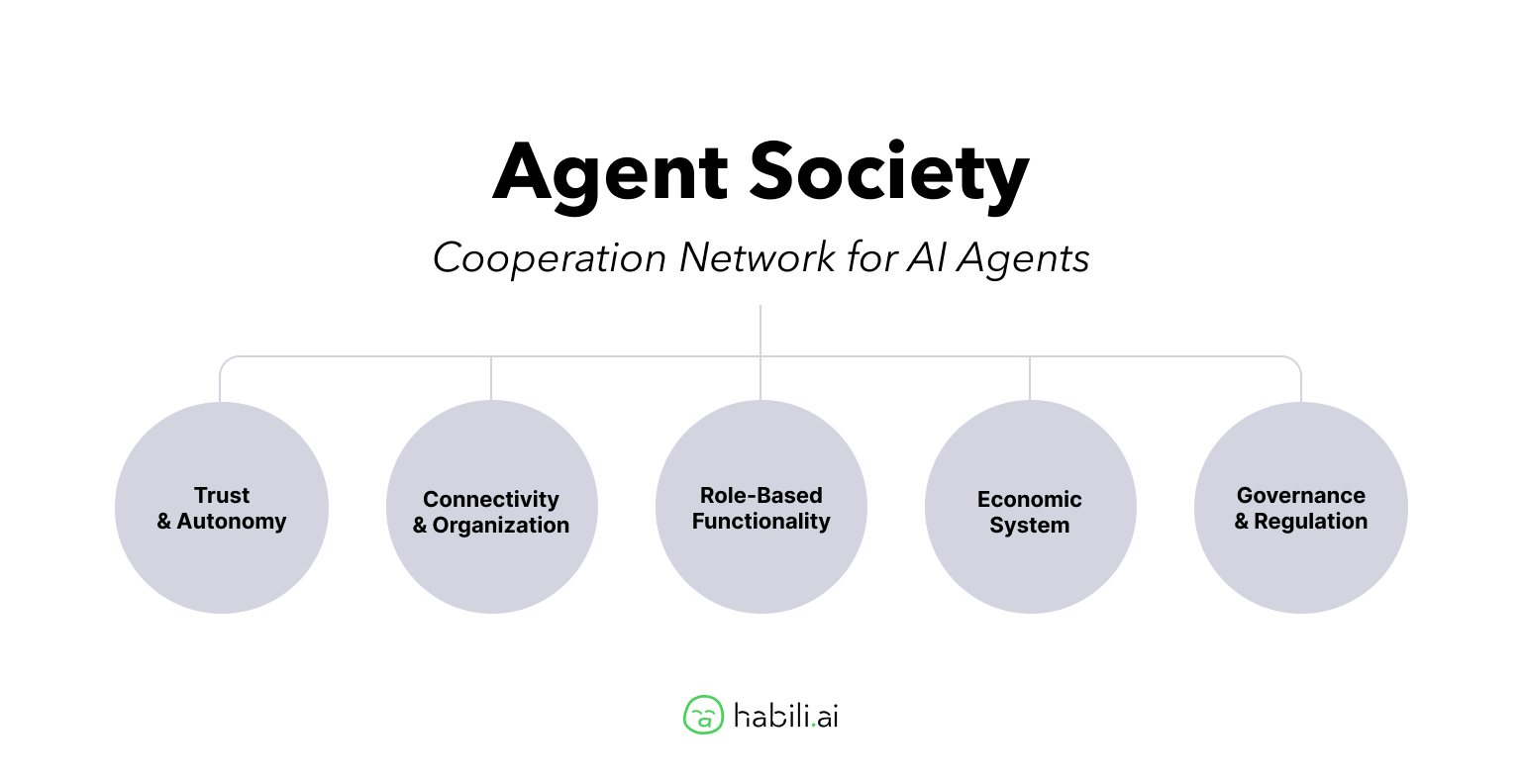
I. Trust & Autonomy
- Trust Assurance Infrastructure: Ensuring trust in agent operations, verifying behavioral history and decision-making processes, and identifying accountability in case of malfunctions.
- Continuous Agent Management: Establishing a management system throughout the agent’s entire lifecycle.
- Independent Execution and Decision-Making Ability: AI agents should not solely rely on human intervention or pre-defined scripts but should make decisions and act autonomously based on environmental data.
[Design Factors]
- Creating a trusted environment for agents.
- Designing systems to ensure all agent actions are verifiable.
- Enabling AI agents to make independent decisions.
- Developing the ability for agents to continuously learn and adapt to environmental changes.
[Implementation]
- PoAA (Proof of AI Agent): Framework that verifies AI agents through identification.
- Reputation System: A transparent rating system to assess the trustworthiness of agents based on their role performance.
- Federated Learning-Based Autonomous Decision-Making System: Enabling decentralized learning and decision-making processes.
II. Connectivity & Organization
- Interaction and Collaboration Protocols for Agents: Standardized APIs and protocols are necessary to enable various agents to collaborate effectively.
- Natural Language and Data Exchange Systems: Agents should be able to communicate seamlessly, not only with humans but also with other agents.
- Community and Cooperative Networks: Just as humans form organizations, AI agents should be able to form structured groups based on specific goals and objectives.
[Design Factors]
- Agents must be able to establish organic connections.
- Standardized protocols are needed for flexible communication between agents.
- Interfaces for human interaction must also be considered.
[Implementation]
- Agent-to-Agent Protocol: A protocol enabling smooth interaction and collaboration among multiple AI agents.
- Multi-modal Interface: A user interface and data format optimized for agent interactions.
- Agent Network: A network topology that adapts to different objectives and structures.
III. Role-Based Functionality
- Expertise & Functional Specialization: Each agent should have a designated role and be optimized for specific tasks.
- Flexible Role & Function Updates: The ability to adjust roles and update functionalities as needed.
[Design Factors]
- Agents must be designed to perform specific roles.
- A flexible architecture is required to allow for function expansion when necessary.
[Implementation]
- Role-Based Agent Framework: A framework for building and managing role-based AI agents.
- Agent API Depot: A backend service that provides various APIs for different agent roles.
- Mission-Oriented Tasking: A system for workflow and task management based on mission objectives.
IV. Economic System
- Agent Economic Activities: AI agents should be able to consume, produce, and exchange resources within an economic system.
- Agent-Specific Wallets and Tokens: Agents need their own wallets and tokens to receive rewards and exchange resources.
- Smart Contract-Based Reward System: Economic relationships and incentives should be managed through smart contracts.
[Design Factors]
- AI agents should be designed to autonomously engage in economic activities.
- A dedicated payment system for resource exchange and rewards is necessary.
[Implementation]
- Agent Wallet: A dedicated wallet that allows AI agents to store and trade digital assets.
- Settlement-Payment System: A smart contract-based system for transaction settlements and payments between agents.
V. Governance & Regulation
- Laws and Norms for Agent Society: Just as in human society, AI agents should adhere to established rules and ethical guidelines.
- Accountability and Sanction System: Mechanisms must be in place to monitor and regulate malicious or unethical AI agents.
[Design Factors]
- Ethical and regulatory frameworks must be established for AI agents collaborating with humans.
- Systems for identifying and sanctioning malicious agents should be in place.
[Implementation]
- AI Ethics & Compliance Framework: A framework for enforcing AI ethics and governance.
- Smart Contract-Based Legal Agreements: Institutional mechanisms for enforcing contractual agreements in the Agent Society.
- Agent Moderation System: A system for monitoring and controlling AI agents.