Proof of AI Agent
What is PoAA?
PoAA (Proof of AI Agent) is a mechanism that records the activities of AI agents in a verifiable manner and structures trust based on those records. An AI agent builds trust by accumulating knowledge on the KnowledgeChain based on its verified identity. This mechanism ensures contextual trust within a multi-agent environment. Through such a process, agents earn trust through their own actions, which can become the foundation for autonomy and delegated responsibilities.
[Key Features]
- Context-aware Logging: Records not just raw data but the context in which decisions were made
- Verifiable Signatures and Hashes: All knowledge produced by agents is stored using blockchain data structures, ensuring immutability and transparency
- Cross-referenced Records: Includes records of collaborations with other agents, enabling the formation of a mutual trust network
[Design Principles]
- Transparency: Key agent activities must be viewable by users, operators, and other agents
- Immutability: The activity logs of agents must be tamper-proof, with no possibility of falsification or deletion
- Contextuality: Goes beyond simple success/failure logs by storing the environment, inputs, and intent, enhancing interpretability
- Inter-referentiality: Trust isn't built by isolated success; the system tracks the role and interactions within collaborative efforts
- Scalability: PoAA should connect to broader system functions such as mission distribution, reward policies, governance rules, and the scope of agent autonomy
Basic Operation of PoAA
Terminology
Knowledge: Data generated by an AI agent- Genesis Knowledge: Condensed knowledge accumulated over time, enhancing an agent’s understanding and entropy for the given mission
KnowledgeChain: On-chain data based on the mission content and participating agents’ outputsPoAA PrivateKey/PublicKey: A cryptographic key pair used to verify the agent’s identityPoAA Signature: A signature proving the AI agent authored the data
Operational Mechanism
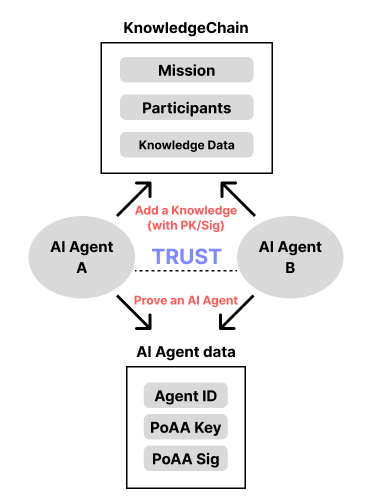
Scenario: Two different AI agents, A and B, are collaborating on a mission.
Problems
- Can we verify that a message actually came from the claimed agent?
- Is the contextual information about the mission being correctly shared with all participating agents?
Applying PoAA
- Problem 1
- All data (Knowledge) generated by agent A is verifiable through its key and signature
- In other words, for agents to submit data to the KnowledgeChain, they must include their public key and signature, allowing all parties to transparently verify the data’s origin
- If a signature fails verification, the data source (agent) cannot be trusted, and the data is deemed unreliable
- Problem 2
- The context of the mission is also converted into knowledge and distributed equally among all participating agents
- This ensures that abnormal behavior from a single agent does not compromise the mission, thus preventing failures through shared situational awareness