Role-based AI Agents
AI Agent
Definition
An AI Agent is a software entity that operates autonomously as an independent system and interacts with tools and systems.
- Autonomous: Capable of making decisions without human intervention
- Independent: Operates as a self-contained system
- Interactive: Communicates with external systems and environments
Types of Agents
Although there is no universally established taxonomy, AI Agents can be broadly categorized by their functional orientation:
- Collaborative Agents: Perform specific roles in task environments, collaborating with humans to increase productivity (e.g., AI developers)
- Supportive Agents: Act as assistants that provide support across daily activities, similar to personal assistants (e.g., AI secretary)
- Delegated Agents: Operate as proxies for humans, handling tasks with low risk or low decision-making complexity (e.g., robo-advisors)
Components of an Agent
AI Agents are designed to mirror the structural and functional characteristics of humans. Their components include:
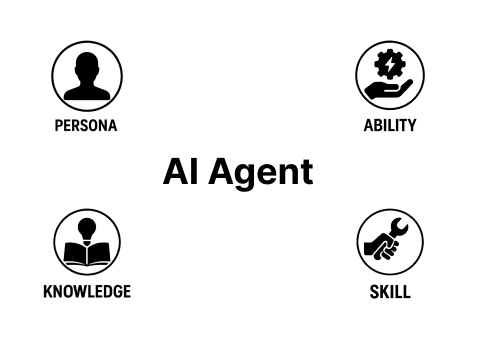
1. Persona
The personality and identity that the agent expresses during interaction.
| Attribute | Description | Examples |
|---|---|---|
| Name | Unique identifier | Chloe, Siri, Jarvis |
| Personality Traits | Behavioral tendencies | Friendly, humorous, serious |
| Emotional Expression | Interactional emotional feedback | Comforting, encouraging |
| Conversational Style | Manner of speech | Formal, casual |
| Persona Type | Role identity | Support agent, consultant, companion |
2. Ability
The overall capacity to perform tasks or solve problems.
| Attribute | Description | Examples |
|---|---|---|
| Cognitive Abilities | Understanding and processing | Natural language understanding, pattern recognition |
| Reasoning | Problem-solving logic | Causal reasoning, decision-making |
| Interaction Capabilities | Communication modes | Voice, text, multimodal |
| Learning Capabilities | Learning new knowledge | Reinforcement learning, supervised learning |
| Adaptability | Contextual responsiveness | Personalization, context-awareness |
3. Skill
Functional capabilities for performing specific tasks.
| Attribute | Description | Examples |
|---|---|---|
| Skill Name | Name of the function | Weather inquiry, scheduling |
| Skill Type | Category of function | Q&A, recommendations |
| Input Format | Required input type | Text, voice, image |
| Output Format | Output type | Text, image, voice |
| Accuracy | Performance metric | 95% image classification accuracy |
4. Knowledge
Structured and unstructured information that the agent possesses.
| Attribute | Description | Examples |
|---|---|---|
| Domain | Specialized areas | Healthcare, finance, education |
| Source | Information origin | Wikipedia, databases, papers |
| Currency | Update recency | As of March 2024 |
| Depth of Knowledge | Expertise level | General vs. expert knowledge |
| Representation | Data structure | Ontology, knowledge graphs |
Role-based AI Agents
Role
Future AI agents will be assigned distinct roles, much like humans. Based on these roles, they will be authorized to perform missions and operate within defined boundaries. Rather than R&R (Roles and Responsibilities), agents will follow the concept of R&A (Roles and Authorization).
Mission
A mission refers to a goal or objective the agent must accomplish. Missions vary in form and are contextually assigned based on the agent's role, guiding the execution of tasks.
Workflow
To achieve a mission, agents construct workflows—sequences of tasks designed to fulfill a goal. These workflows may involve internal models or external APIs. For example:
-
Creating a Meeting Schedule Workflow

- Search for a suitable venue based on meeting purpose and constraints using a map API
- Purpose: "Book Club Meeting"
- Attendees: 5 people
- Availability: Weekend
- Reserve the selected venue via booking API
- Register the confirmed event on a calendar via calendar API
- Send notifications to attendees using a messenger API
- Search for a suitable venue based on meeting purpose and constraints using a map API
Task
A task is the smallest unit of work an agent can perform. Tasks are defined by specifications and can number in the thousands depending on mission complexity.
Example: Role-based Agent
- Role: Home management agent
- Mission:
- Maintain home cleanliness
- Optimize indoor environment (temperature, humidity, air quality)
- Tasks:
- Cleaning
- Waste sorting
- Operating air purifier
- Adjusting temperature
- Running dehumidifier
- Doing laundry